Major
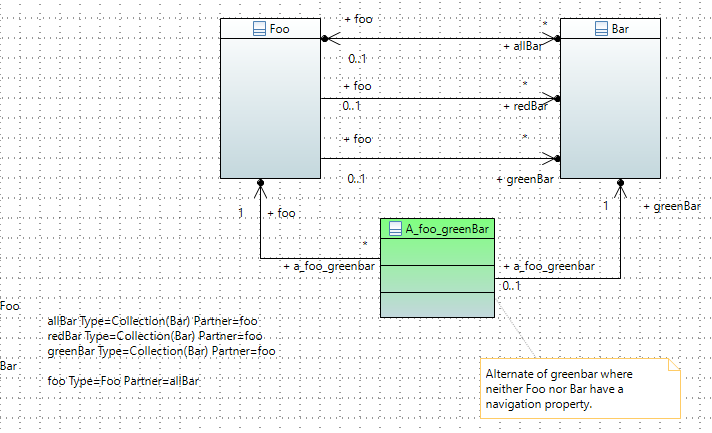
Major Consider the following scenario:
- Foo
- allBar Type=Collection(Bar) Partner=foo
- redBar Type=Collection(Bar) Partner=foo
- greenBar Type=Collection(Bar) Partner=foo
- Bar
- foo Type=Foo Partner=allBar
These partner navigation properties satisfy the basic rules
If the partner navigation property is single-valued, it MUST lead back to the source entity from all related entities. If the partner navigation property is collection-valued, the source entity MUST be part of that collection.
In addition this model clearly expresses that the pair (Foo/allBar, Bar/foo) forms a bi-directional relationship, and the other two navigation properties on Foo are uni-directional with a back-link.
Unfortunately this model violates the last paragraph in CSDL section 8.3 Partner Navigation Property
If a partner navigation property is specified, this partner navigation property MUST either specify the current navigation property as its partner to define a bi-directional relationship or it MUST NOT specify a partner navigation property. The latter can occur if the partner navigation property is defined on a complex type, or if the current navigation property is defined on a type derived from the type of the partner navigation property.
A spec-compliant model would have to hide useful information, either
- remove Partner=allBar from Bar/foo, or
- remove Partner=foo from Foo/redBar and Foo/greenBar